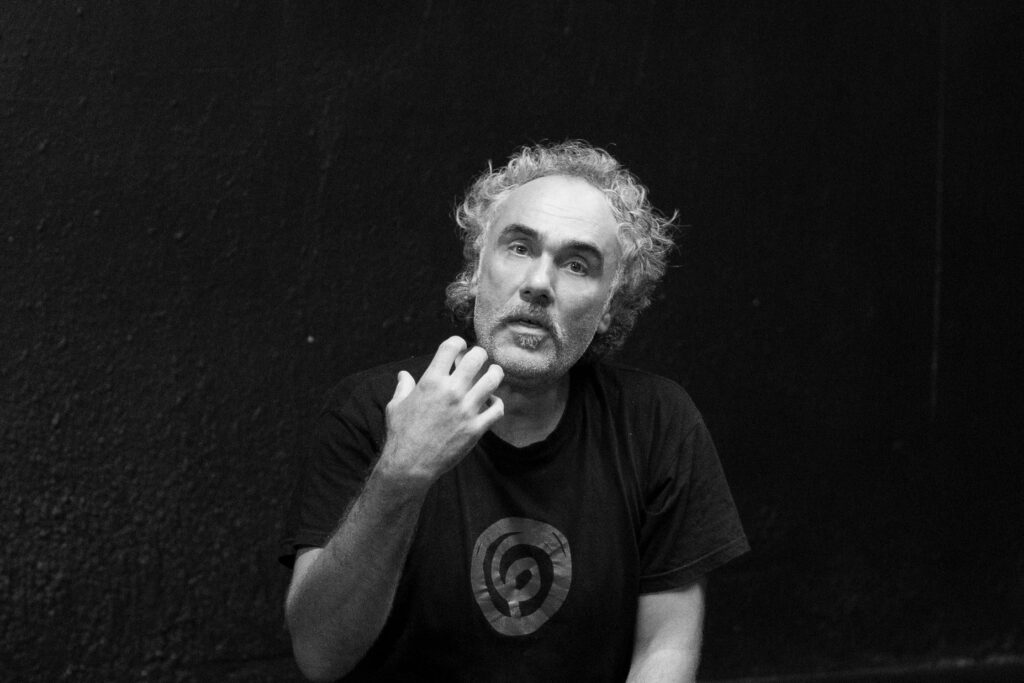
Henryk Mazurkiewicz in conversation with Fanis Katehos, a theatre maker (actor, pedagogue, director) and co-founder of the Fabrica Athens group
Henryk Mazurkiewicz: Approximately how many independent theatres are currently active in Athens — or perhaps, more broadly — in Greece?
Fanis Katehos: I don’t know the exact number, but from what I’m aware of, there are around 2000 independent theatre groups — some larger, some smaller. Not all of them are very active, but I’d say roughly that number, mostly based here in Athens, with a few more around the country.
HM: How do you understand the term ‘independent theatre’ in the context of Athens and Greece? Are there any debates about its definition?
FK: There isn’t really an official definition of what constitutes an independent theatre group. In practice, most small groups are independent simply because they receive no support from the government or municipalities. In Greece, we have two major national theatres and a few large foundations — and all the others operate completely on their own. Some independent actors may occasionally receive state support, but that’s rare.
We have about 10,000 actors in Greece, and only around 200 or 300 of them can actually make a living as actors each year. The rest try to survive by forming small theatre groups and finding creative ways to keep going. So that’s the main difference: big institutions on one side, and small, self-organized groups struggling to survive on the other. That’s essentially what we mean by independent.
Most of these independent groups, as I said, don’t earn enough to live off their theatre work. They make theatre, but they also have other jobs to pay the bills. The very idea of a theatre group is complicated here. Let me give you a small example: when students graduate from theatre schools, they’re usually trained for television or institutional theatre — to audition for the National Theatre or similar venues. But when they leave school, they can’t find work, so they start their own groups.
However, these groups are often formed not out of shared artistic passion but simply out of necessity — to have somewhere to perform. And when one of the members finds a job after six months or a year, the group often falls apart. There’s little sense of continuity or long-term commitment to the idea of a collective.

That’s why long-lasting groups — those that have been active for 10 or 20 years — are rare. One example is Fabrica Athens, which has existed for about 20 years. But such examples are few. We lack the structure and stability that would allow groups to grow and develop over time. Maybe others will tell you something different, but that’s how I see it. The problem starts already in theatre schools, which don’t teach the kind of collaborative, collective approach that’s essential for creating enduring theatre groups.
HM: What does a typical independent theatre in Greece look like? Beyond the lack of financial support, is there something that unites them?
FK: The most incredible thing about Athens — about Greece in general — is the deep, genuine need people have inside them to make theatre. They really want to do it. They spend their own money, they work extra jobs, just to be able to create. Many even turn their homes into small theatre spaces.
It’s amazing, really — this determination to keep doing theatre at any cost. And that, to me, feels like a miracle. Around 2000 small theatres, all of them surviving without real funding, and yet they continue. Every year more people study theatre, go to drama schools, form groups. There’s this constant renewal.
You might think it would be impossible to sustain, but somehow it keeps going. There’s this unstoppable urge to perform, to create. That need is both a blessing and a problem — it drives people forward, but it also exposes how fragile the whole system is.
HM: Why do you think independent theatres in Athens and Greece receive so little institutional support?
FK: There are several reasons. First, Greece isn’t a theatre destination like London or Berlin. Tourists don’t come here to see plays. Maybe the language is a barrier, but also the government and municipalities have never really tried to make Athens or Greece a place people associate with theatre. There isn’t that kind of infrastructure or international visibility.
So, we don’t have the same audience base to sustain all these small groups. And Greece has been in crisis for many years now. The government doesn’t really care about artists — in fact, sometimes it feels like they’re against us. The small amount of cultural funding that exists goes almost entirely to the big institutions, maybe 10 of them at most. For everyone else, there’s practically nothing.
Sometimes, once in five years, a group might receive 5000 euros. But that’s not real support. There are many empty buildings that could be used for art, for rehearsals, for performances — yet they just sit abandoned. Even offering space, not money, would make a difference. But that doesn’t happen either.
And then there’s the problem of funding structures. You can apply for a grant once a year, but everyone applies: big institutions, well-known artists and tiny independent groups. The competition is overwhelming and the money almost always goes to those who are already established and well connected. There’s no mechanism to help new groups get started or to support independent theatres directly.
Everything is thrown into the same pot — theatre, circus, festivals, everything. It’s not a sustainable system. What we really need is a new, fairer model of funding and support.
HM: It’s strange, isn’t it — people come to Greece to see antiquity, and theatre was born here, yet they rarely come to see theatre. Has the lack of funding and grants always been like this, or has that changed over the last 20–30 years?
FK: I’d say it’s been fairly consistent. It hasn’t really gotten better. After Greece joined the European Union, some groups — like ours — managed to access European projects and partnerships. But most theatre groups don’t yet know how to navigate that system, so only a few build those connections across Europe and actually secure support. In other words, whatever help there is often comes from outside Greece, not within it.
Let me give a concrete example of how we’ve survived locally. We began doing more circus-style work — parades and street entertainment — because some municipalities have bigger budgets for Christmas, Carnival and similar events. So, we learned stilt-walking, bubble shows, even big spectacle elements, and toured villages and cities that invite artists for seasonal celebrations. That’s how we brought in some money. It’s not ideal, but it kept the group alive.
HM: You’ve partly answered my next question, but I’d like to hear more. With so many independent theatres, why don’t they unite and fight together as a collective force? Have there been attempts to build networks, federations or unions — and what became of them?
FK: This is a big question. There are countless small groups, and most members work other jobs; they rehearse in the evenings. Groups like ours that live from theatre often work 20 hours a day. There’s simply no time left to build the kind of ecosystem where people meet regularly, discuss common issues and go knock on the municipality’s door together. Organizing takes time — free time — and that’s the one thing we don’t have.
But when something serious happens, we come together immediately. About 10 years ago, one or two large institutions looked at all the small venues around Athens and decided they were ‘stealing’ the audience. They used an old regulation — a law dating back to 1896, from a period when there were only a handful of theatres — to shut down many of these small spaces. In response, we organized a union, consulted colleagues in London about how their system works, drafted a proposal and lobbied the municipality. We managed to change the regulation and we kept our spaces.
Something similar happened recently with diploma recognition. For a time, our theatre-school diplomas were treated as if they were worthless. Artists mobilized again and pushed back. So yes, when a crisis hits, we unite and act. Day to day, though, finding common time and space to sustain that level of coordination is very difficult.
HM: How much attention do independent theatres get from the press, media and critics? Are there any magazines or online platforms dedicated to the independent scene?
FK: It’s the same story as before: almost no one is interested. Journalists look for the bigger stages and famous names. Critics rarely go to small venues to see what’s happening there — even though they might discover something truly special.
There’s another phenomenon people sometimes label as ‘theatre groups’. A well-known director gets funding for a production and invites collaborators — some famous, some not — to create it. They might work together again a couple of years later, but they don’t share a life as a company. They don’t build a common practice, face common fears or sustain a daily rehearsal rhythm. They collaborate to deliver a single project. Is that really a theatre group?
So, the question keeps returning: what is an independent theatre group? For me, it’s a company where people share their lives, invent independent ways to survive, explore new forms together and play together day after day. That’s different from a temporary project assembled around one production.
HM: And what about Greek universities? Have you received any support from the academic world?
FK: Generally, no. In some cases, yes. Take our company, Fabrica Athens — we’ve been working together for 20 years, which is unusual in Greece. Longevity changes the picture. After 20 years, critics might finally come and see your work. Academics may begin researching: ‘Here’s a group that has stayed together for two decades — let’s talk to them.’ The same is with the Handmade and Recycled Theatre Festival. After thirteen editions, academics have started to pay attention — partly because the festival brings together many companies you might know, like Teatr Brama, Antagon TheaterAKTion or Potlach Theatre, and partly because it has become an international platform where we host activities from abroad, welcoming guests such as Eugenio Barba along with many other friends and groups.
All this stands alongside our wider work — theatre in prisons, community projects, performances with people with disabilities, indoor and outdoor shows, running three spaces in the centre of Athens, engaging with so many different topics — so now researchers are trying to understand what we do and how we do it. Still, it’s rare for universities to seek out independent groups in any systematic way.
HM: You mentioned the festival. How do you handle funding, budgeting, partners and audiences?
FK: Every year we say we won’t do it again — because it’s a huge amount of work and we invest our own money to keep it alive. In the last three or four years we’ve started receiving small public grants, but they’re modest: one year it was €5000, then €8000, then €10,000. With sums like that, we can cover only the basics — printing, essential production costs, a few fees.
From the beginning, the festival has been built on contribution. We offer our time, our space and our know‑how. Throughout the year, we set aside part of what we earn from our own projects into a ‘festival box’. Friends and collaborators pitch in — sometimes working for free or at symbolic rates. We don’t sell tickets; it’s donation-based. That means we never raise much this way — maybe €1000 across the entire festival — but it keeps the doors open to people who normally can’t afford theatre.
Our aim is to present high-quality work while staying accessible. So, every year we look for new solutions: small local sponsors (a shop gives €20 or €50 and we include their logo on the poster), in‑kind support, partnerships. Recently, a little help from the Ministry of Culture has allowed us to add residencies or exchange programmes — for example, collaborations with partners in Germany — which brings in a bit more support to host artists.
Mostly, though, we shoulder the festival ourselves. Sometimes visiting companies already have travel funding, which makes it possible for them to join us. When that happens, we welcome them with open arms — it’s one of the few ways to expand the programme without increasing our costs.
HM: You’ve explained the festival side, but how does your company’s financial model work? Where do you find the resources to sustain yourselves for so many years?
FK: In the beginning, most of us worked other jobs and met in the evenings to rehearse and make shows. Because we had no money, we did everything ourselves: sets, costumes, lights — everything. We’d spend five, six, even eight months creating a piece, then rent a venue to present it. The ticket income barely covered the rental, so we decided to build our own space — a small studio where we could rehearse and teach workshops.
We built it ourselves, from the floor to the lights. At first it was only for rehearsals and classes, but then we started renting it out — for rehearsals, seminars, workshops, small concerts — at very low rates, just enough to cover expenses. That helped us stop paying out of pocket every month.
Still, we had the same problem with performances: renting theatres absorbed all the ticket revenue. So, we created our own tiny venue, 40–50 seats, again handmade and recycled. We found materials on the street — even old wooden utility poles that we turned into audience benches — and transformed what other people threw away. With our own stage, we could show work and also rent the space to other groups, again for a symbolic fee, which made us the most affordable venue in Athens.
That’s when we launched the festival — to bring together artists who shared this zero‑budget ethos and see what could emerge. Meanwhile, our building had an empty floor above the basement. The owner wanted to rent it to a flamenco group, but the noise would make our basement unusable. So, we took the upstairs space and asked ourselves: another stage? Instead, we opened a bar.
There’s a joke here — when you say you’re an artist, people ask, ‘Which bar do you work in?’ We thought: let’s run our bar. If we operate it ourselves, we can earn daily income, stay together throughout the day and rehearse whenever we need. That’s exactly what happened. The bar and our small stage became a meeting point for artists across Athens — a place to talk, find collaborators and have fun. It’s still one of the city’s key artistic hangouts.
We also learned skills that could generate income: acrobatics, street performance, parade work — especially around Christmas and Carnival — which kept us going for years. Then we began touring the countryside. Big theatres rarely visit remote villages in the mountains, so we went there to offer workshops, concerts, small performances — often for free at first. People invited us back and eventually found modest funds to host us.
Another turning point came through European exchanges. I joined a training programme (Erasmus) where the designated teacher dropped out. I stepped in to lead the workshop and we involved local refugees in the final performance. The organizers were delighted and asked us to develop more projects. That led to long‑term exchanges with partners in Germany and elsewhere — a way into the European project world.
We also started working in prisons, initially as volunteers for five or six years, simply because we believed in it. Later, limited funding became available and we could continue more sustainably. This is our pattern: we start by giving our time and energy, then we look for ways to support the activity financially so it can last.
So yes — we’re resourceful. We arrive somewhere, create something with what we have and then figure out how to survive from it. It’s not a perfect system, and social security remains precarious for most artists. But this mix — our own spaces, a community bar, street work, rural tours, festivals and European collaborations — is how we’ve managed to keep going.
HM: Please, tell me more about your audience.
FK: Because our work is a bit alternative — less institutional, more experimental — it took time to build an audience. We found a path through community. Many of the people around us are young artists or students from drama and dance schools who take small jobs to survive or pay tuition. Our bar became a gathering place for them: they’d come for a concert or a coffee, and over time they became friends. The groups that rent our rehearsal rooms and our small theatre also become part of that circle — and friends come back to see our shows.
We do a lot of community work — ‘theatre for the community’ and ‘theatre with the community’. Workshops and seminars bring in many students every year and they eventually come to our performances. The festival helps, too. We give ourselves in service to other artists and they feel that; later they return to support our premieres, classes and events. Slowly, over the years, what we gave with an open heart has come back through a network of friends and supporters.
Two principles shaped this audience. First: we are together but independent. Our group is open, not closed; the door is always open for people to join us for as long as they wish. Second: we don’t ‘own’ anything. If someone needs a projector, we lend ours. In practice, one projector serves 10 groups. We borrow in the same way when we need something. This culture of sharing — tools, spaces, skills — has built trust. People don’t attend just to ‘watch a show’; they come as friends who want to sustain a living community.
Our main inspiration in this has been Eugenio Barba. After 20 years I can say he is our master — his example of a theatre group sustained over six decades encourages us to keep working together for thirty, forty, fifty years.
HM: What is the situation of the younger generation of theatre-makers in Greece compared to your own? Are young artists interested in political theatre — do you sense a desire to engage with the current social and political crises?
FK: I think the younger generation is exceptionally smart and very quick. Everything moves fast for them — information, images, jokes on a smartphone — and they expect results at the same speed. What they need is time: the patience to let things mature. One mistake we ‘older’ theatre-makers make is assuming we already know. We should step back, put the new generation out front, ask questions and learn from them. Even our sense of humour is different now — many jokes live on TikTok, and if we don’t understand that language, we miss a lot. In a way, the young should be our teachers and we should take the role of students. Then we can better understand what support they actually need.
HM: Which topics feel most urgent to them today — especially in Greece? What do they want to talk about on stage?
FK: It changes with each period. During the pandemic, everyone wanted to speak about Covid. A year ago, a wave of femicides dominated the news, and people focused on violence against women and breaking the stereotypes that enable it. Now the political climate is tense, so many want to address that. Every year a new issue rises to the surface. The impulse to ‘make a revolution’ is strong among young artists, so they speak about the moment they’re living in.
At the same time, I see a parallel trend: some put huge effort into Instagram or TikTok because the industry sometimes rewards follower counts over craft. I’ve been at auditions where someone says, ‘I have 10,000 followers’, and the director lights up. So young artists face a dilemma: do you invest those 10 hours a day in social media or in rehearsal? It’s a tricky choice in today’s survival economy.
HM: If you were to give these young artists a piece of advice — something about keeping their passion for theatre alive over the years — what would it be?
FK: Think of theatre as a building. If you want to place even a small stone in that structure, stay. Keep working, contribute what you can, and you’ll find joy, a path and companions. But if your impulse is to take a stone out — if theatre is just a vehicle for fame or ego — then step away. Humility and contribution are the best conditions for a life in theatre. The rest, in time, will follow.